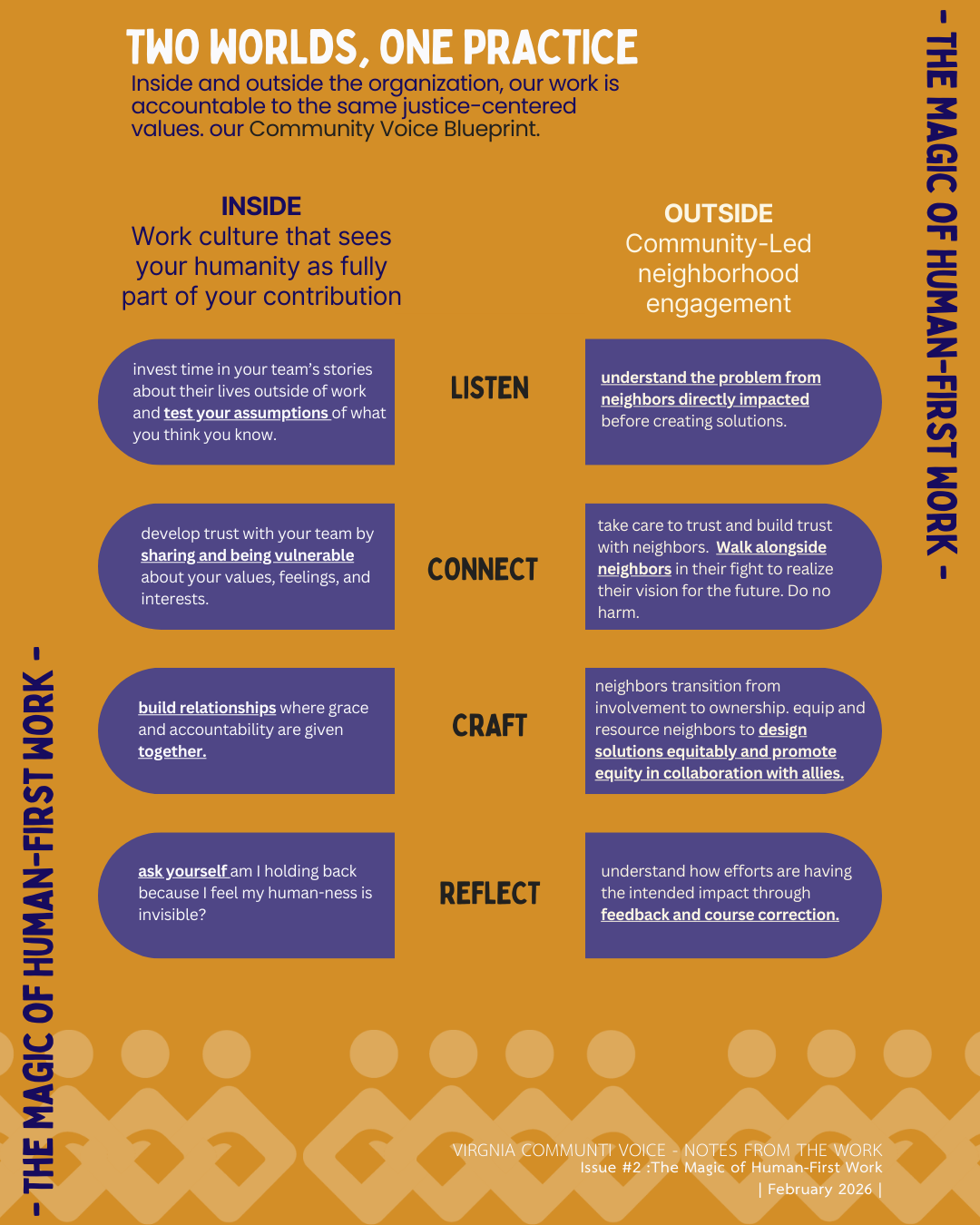
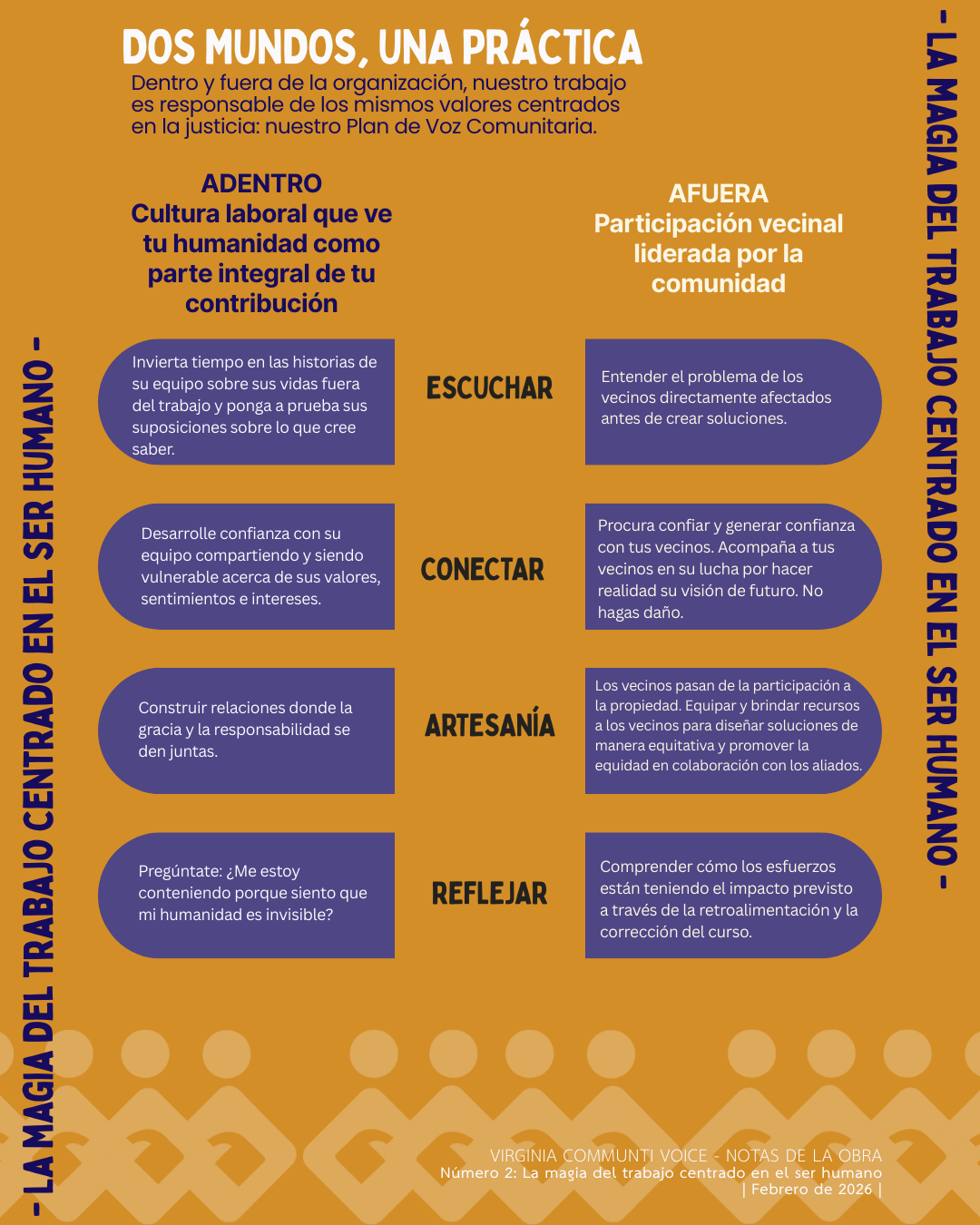
The Magic of Human-First Work
Written by : Rupa Singh
I’m still a bit of a newbie. And that matters.
Because when you’re new, you can still see the magic. After a while, the magic becomes part of you. You stop noticing it. You think it’s just dust. But really, it’s tiny, brilliant, glowing pieces of something rare—something that makes VACV unlike any other workplace I’ve ever known.
Let me start with an email from Lea—our guiding light of a leader.
Hey all,
I wanted to apologize for showing up to the virtual meeting today sick. Pretty sure I have the flu, according to my doctor. If any of you were in my state, I would have told you to go lay down.
It’s hypocritical to hold that standard for y’all and not for myself. I don’t want you seeing me do things like that and thinking you need to do it too. I’ll make a point to set a better example.
Thanks, as always, for your grace as I grow into the leader I want to be. Stay safe and warm tonight.
I was in shock.
I remember thinking: What boss writes this to their employees?
Vulnerable. Accountable. Naming Harm. Asking for grace.
And almost immediately, my shock turned into: Oh. Yeah. Of course.
This is so Lea.
This is how this place operates. This is how justice shows up here.
Justice: Naming Harm and Refusing Productivity at Any Cost
When I say “this is how this place operates,” I mean that above all else, VACV recognizes that we are human beings with full lives outside of work.
Let me say that again, because it matters:
Our lives outside of work are not an inconvenience, they are seen, heard, believed, valued, and worthy of care. VACV actively rejects the systems that tell us our value comes from how much we produce, how much we can endure, or how invisible our needs can be.
In most workplaces, showing up sick is rewarded. Overwork is normalized. Silence is safer than truth.
Here, leadership takes responsibility for harm—no matter how small—and corrects it publicly. That matters. Because justice work begins with accountability, not intention.
This email is a perfect example of that culture in action:
Recognizing that when you aren’t well, you can’t show up well
Recognizing that leadership is modeling boundaries, not ignoring them
Recognizing that you are a human first—and a worker second
That is not standard nonprofit culture. That is a justice stance.
Liberation: Reclaiming Our Humanity
Justice interrupts harm. But liberation asks a different question: What becomes possible when the harm is no longer defining us?
At VACV we don’t check our outside lives at the door. (Also…we don’t even have a door. We’re fully remote.)
As I write this, I’m sitting on my window seat, light pouring in, heater at my feet. I’m working—but my life is fully present with me:
A mother with Alzheimer’s who I care for
Three kids at school
A partner running his own business
And me—learning, slowly, how to make divine space for myself
None of this is hidden at work. None of it needs to be justified. Here, we practice something radical: we allow our whole lives to exist at the same time as our work.
Being able to say “I can’t” because of something happening in your life is a big deal because it’s not treated as failure. It’s treated as information. And here, we say “I can’t” freely—without guilt, without shame, without over-explaining, and without fear of how it will be received. And that freedom is liberating.
Have you ever experienced that at your workplace?
I hadn’t. Not at an architecture firm. Not at a boutique. Not at another nonprofit. Not even when I owned my own business.
Liberation looks like being trusted to know your own limits.
Liberation sounds like saying no without apology.
Liberation feels like not bracing for punishment.
Trust as Power
Now, you might be wondering: Doesn’t a “human-first” policy get abused? Don’t people take advantage of it?
No. They don’t.
Our structure is built on reciprocity in its most magical form: trust. We actually know each other’s lives. Expectation and Compassion live together. That is justice.
When you give people trust in abundance, it comes back as more—more care, more accountability, more commitment.
Everyone arrives here carrying different past experiences. Some of us were treated like productivity machines. This level of trust can feel unfamiliar—and it takes time to learn how to hold it responsibly. Others may have never been expected to stretch themselves, and the expectations here feel unclear at first.
There is tension. And there is space to work through it.
We don’t ignore power. We talk about it. We don’t avoid accountability. We practice it. We expect work to be done. But we never expect anyone to believe they are their work.
That distinction is everything —it is the magic.
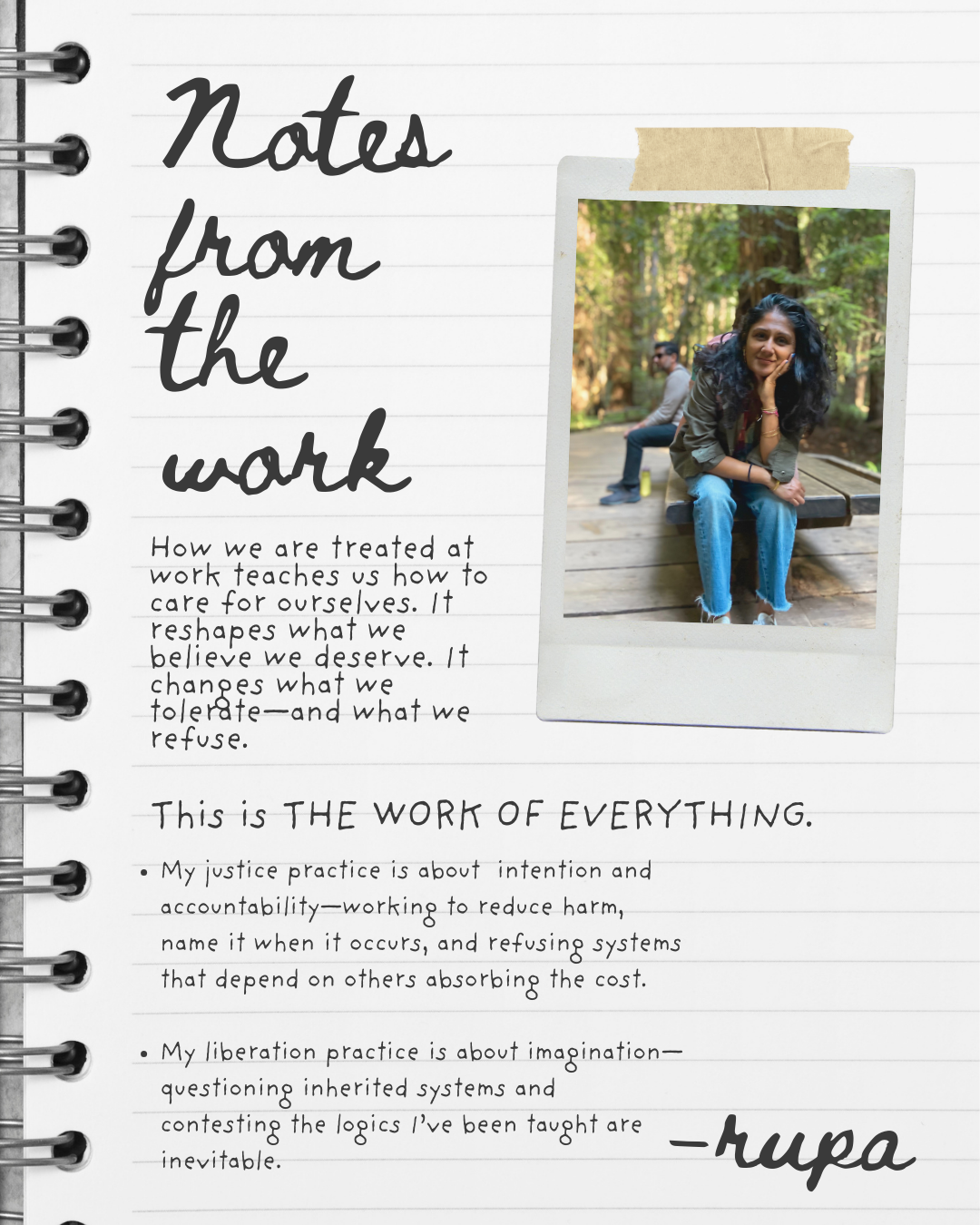
This is THE WORK OF EVERYTHING.
How we are treated at work teaches us how to care for ourselves. It reshapes what we believe we deserve. It changes what we tolerate—and what we refuse.
That’s why this isn’t just workplace culture.
It’s political education.
It’s justice practice.
It’s liberation in real time.
Justice lives in how we name harm, redistribute power, and refuse systems that rely on burnout and fear.
Liberation lives in how we build conditions where people can rest, imagine, choose, and bring their full selves into the work.
We practice this inside our organization because the way we treat each other is already justice work. And we practice it outside because communities deserve institutions that are aligned, accountable, and practice the world they are trying to build.