The foundation to the work of Everything: Self-Interest
Written by : Josh Scott + Justin Sykes
As a father of two rambunctious boys, I’m constantly trying to get them to complete tasks. Everyday it’s “can you take out the trash?” “Can you put away your markers?” ‘Put your shoes on”. Of course, they push back. More often than not, it takes negotiation to get things done.
I chuckle sometimes because it’s not that different from engaging with adult coworkers—or neighbors in our communities. We all want to get something in return when we do something, whether it's tangible or intangible. As Director of Organizing and Policy at VACV, I, Josh, am still struck, nearly fifteen years into this work, by how much understanding self-interest matters and how quickly the work suffers when I don’t prioritize it.
It is the hard and heart work of Virginia Community Voice that we build strong relationships and trust with our neighbors. To truly honor the communities that we work in, it takes many hours of intentional one-to-one conversations so we can understand who people are, what they want, and ensure they understand the same about us.
There is too much at stake to make assumptions about each other.
We invite communities to openly share about themselves so that we can listen intently, discern their self interests, and create opportunities for action that move them closer to what they want for themselves and their neighborhoods.
—
I am Justin Sykes VACV's Healing Justice Coordinator. Practicing a Community organizing style that is focused on self-interest and internal reflection has been a fascinating aspect of this job. I'm learning that self interest is the catalyst to our work. Community change work is about getting conversations started, so I have to ask myself “What gets people fired up? What gets people to stay in the fight? but more importantly why? Why do you show up? Why do you stay? Why are you fighting this hard fight? Why are you saying yes to the hard things?”
What is self-interest?
Self-interest starts with the self - but it is not selfish.
It's key to understanding what motivates us and others to act.
Self-interest is a relational concept. It asks:
What are my interests, in relationship with others?
What do I want for myself, family, community and how does that intersect with what you want?
There are few areas we can explore to identify our own self-interest:
Survival based - “I need”
I need to afford rent.
I need to be mentally and physically well.
Identity based - “I am” “I want to be”
I am a good friend.
I want to be valued in my community.
Relationship based - “I respect/care about”
I care about the green spaces in my neighborhood.
I respect the wisdom of my elders.
Values based - “I believe”
I believe in honesty.
I believe in holding myself and others accountable.
We all care about many things, and sometimes our self-interests compete.
For example, I want Southside residents to build power—which often means night and weekend meetings. I also want to be a present dad, spending time with my sons and helping with homework. Those interests are in tension, so some days I have to choose—or get creative to honor both.
This is why understanding self-interest matters.
We regularly ask neighbors to step into work that will positively challenge them. Without understanding their interests, the answer will likely be no—not because they don’t care, but because they’re balancing competing commitments.
Our role isn’t to convince them one interest matters more. It’s to respect the full picture of their lives. The power of the one-to-one conversation is that it allows us to focus on what they want and how engagement aligns with what already matters to them.
When participation aligns with self-interest, it becomes choice—not pressure.
How does self-interest lead us back to justice and liberation?
In last month's issue of Notes From the Work, Rupa reflected on justice as doing good with intention—being accountable for harm, minimizing it where we can, and refusing systems that require others to absorb the cost.
She also explored liberation as the practice of questioning inherited systems and imagining what becomes possible when we contest the logics we’ve been taught are inevitable.
So where does self-interest fit?
Self-interest is the starting point. Because before doing good with intentions and exploring systems change, people need connection. And people act from what matters to them.
Justice work without understanding self-interest can become paternalistic—people being told, enticed, or convinced what to do, rather than understanding why they would choose to act.
Liberation work without grounding in self-interest can become abstract. You cannot question a system if you have not first connected yourself to the issue. Without that motivation, it stays in conversation—not change.
But when people are clear about what they need, who they are, what they value, and what they care about, justice becomes personal and liberation becomes practical.
Self-interest clarifies what is at stake.
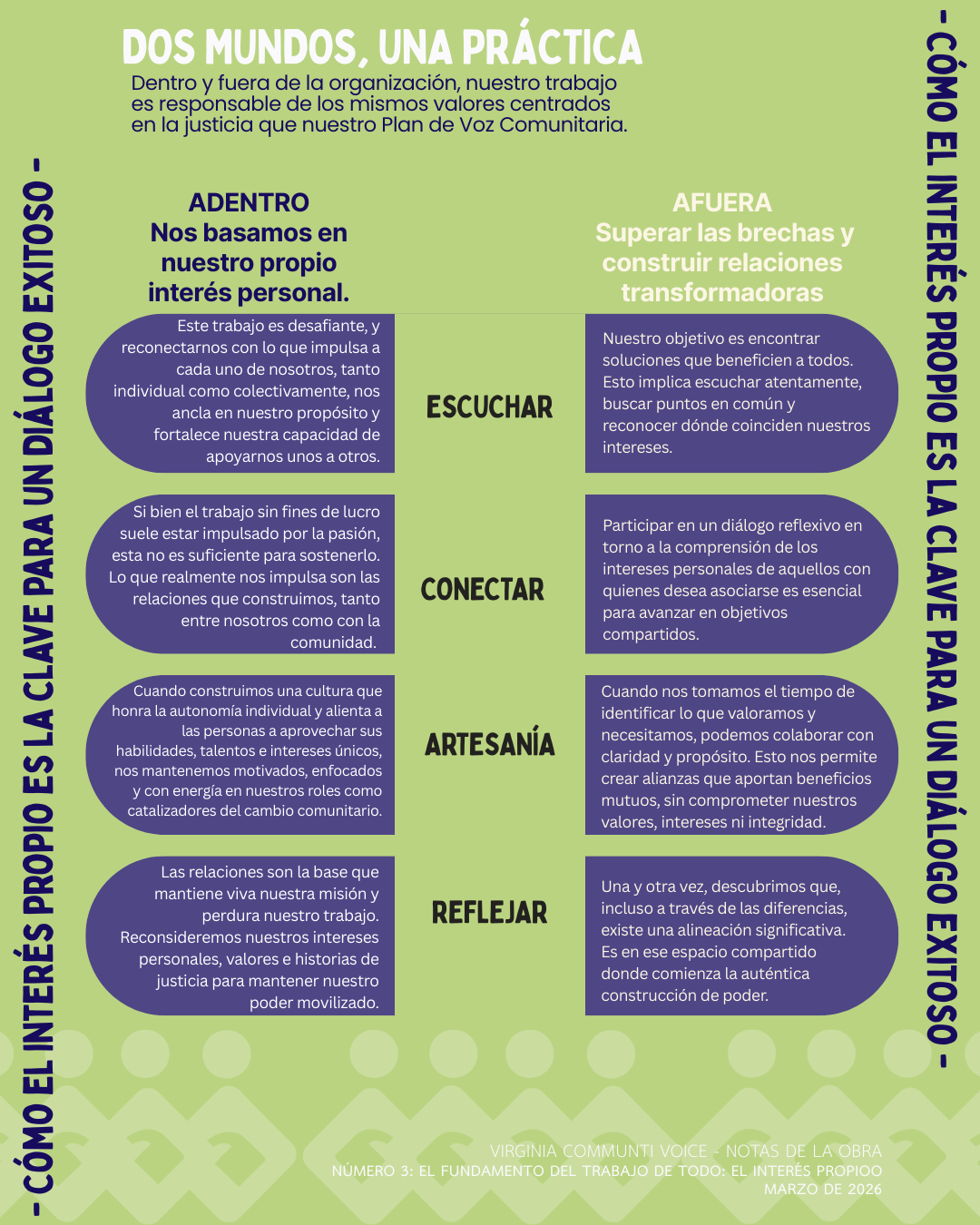
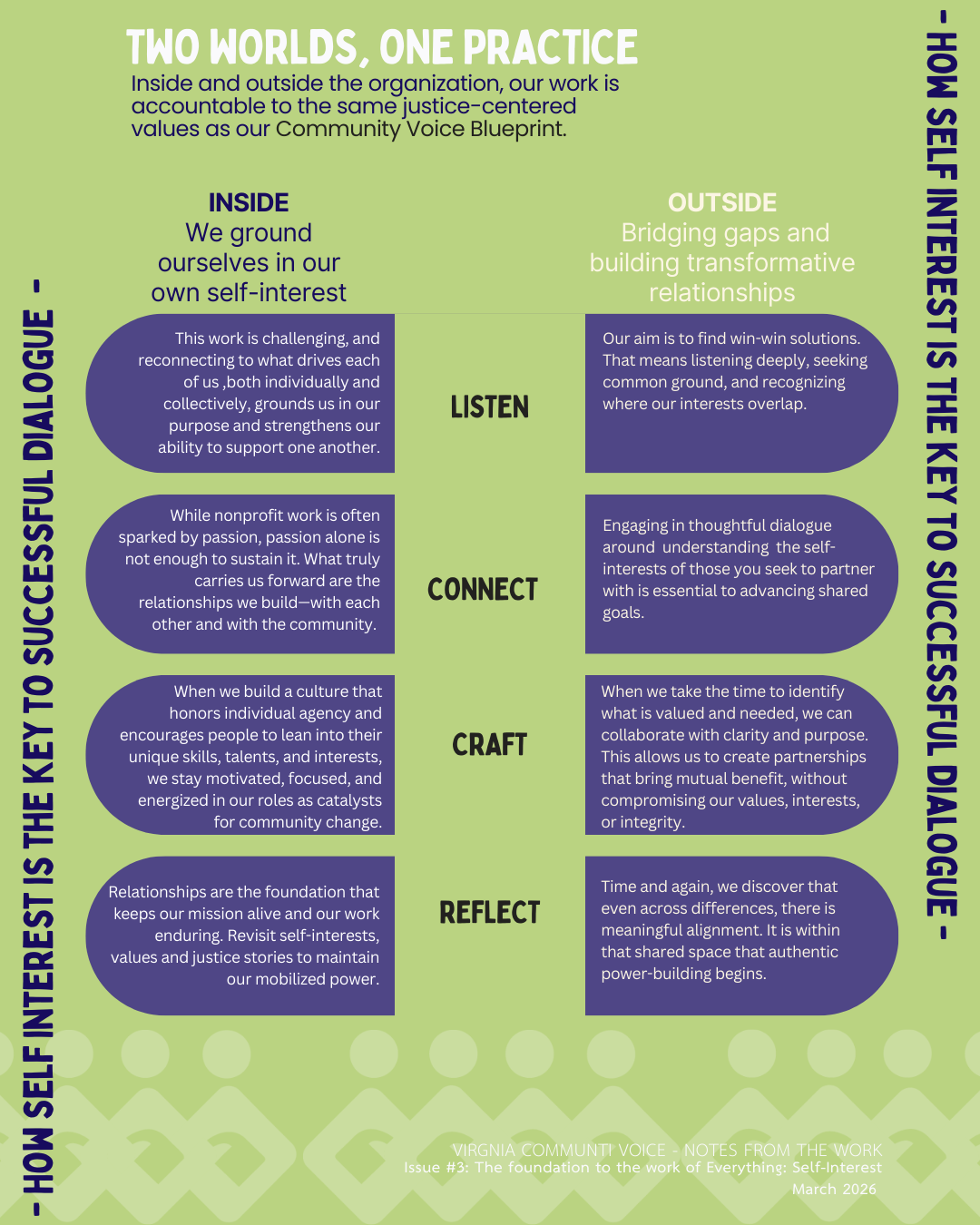
Through intentional dialogue and thoughtful resource gathering, we help community members reconnect with what matters most to them. From there, we create pathways for real agency in shaping their neighborhoods.
When individuals understand their self-interest and are supported in action on it - they move from being impacted by systems to influencing them.
That is justice in practice. That is liberation in motion.
This is THE WORK OF EVERYTHING.
Virginia Community Voice serves as a catalyst organization. We initiate the difficult conversations, engage elected officials with courage and clarity, and stand alongside communities that have experienced intentional disinvestment. We do not simply spark change, we stay to see it through.
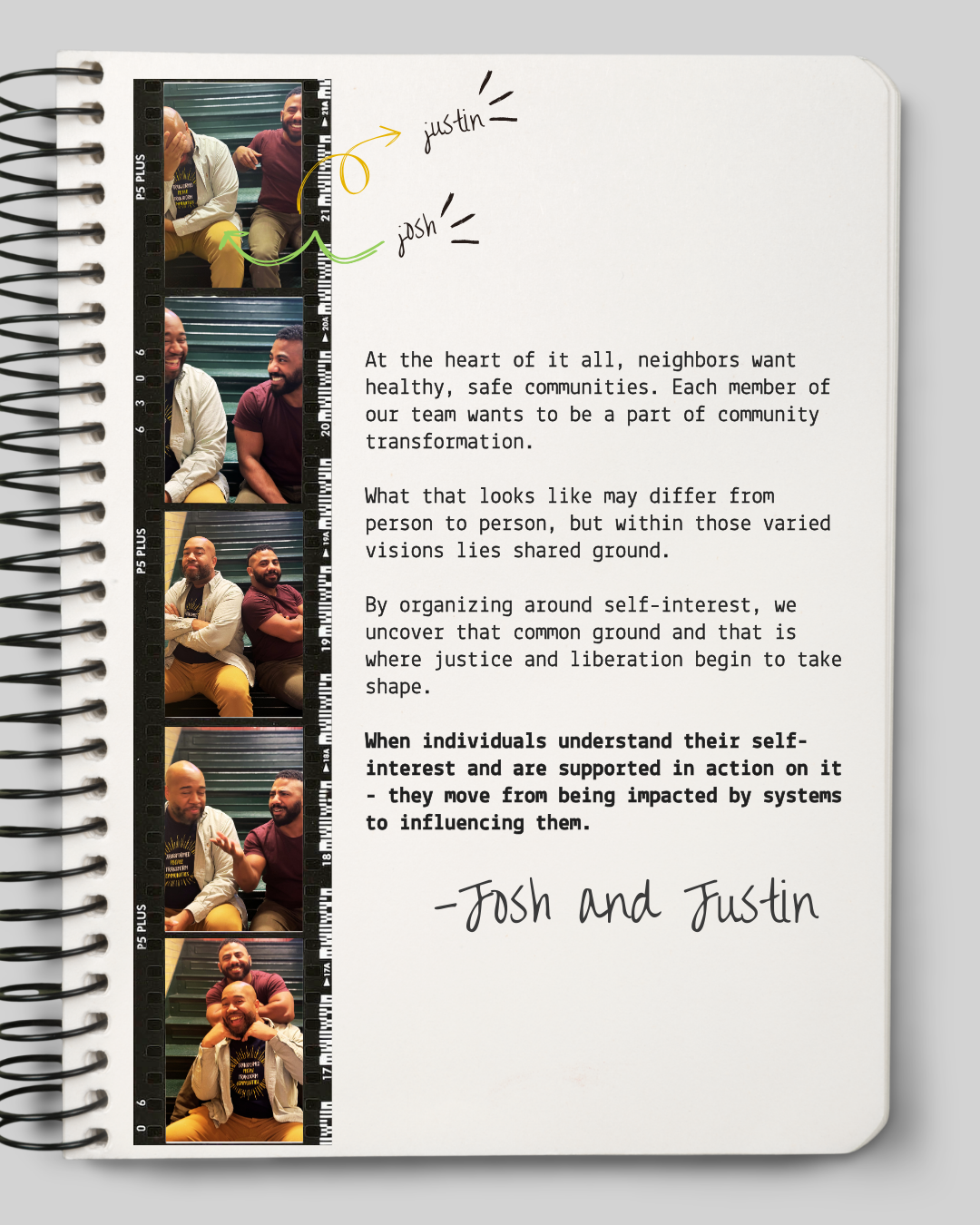
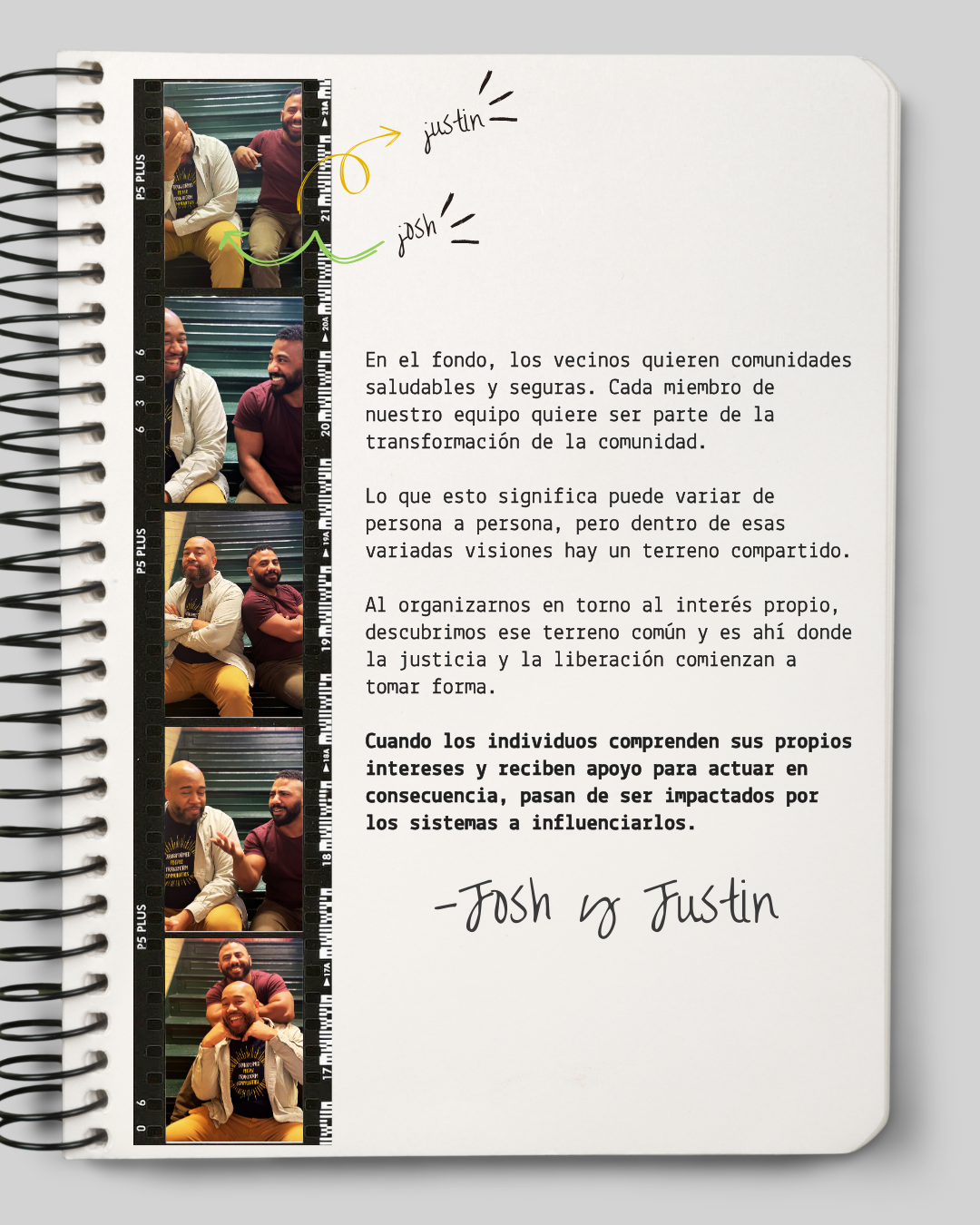
At the heart of it all, neighbors want healthy, safe communities. Each member of our team wants to be a part of community transformation. What that looks like may differ from person to person, but within those varied visions lies shared ground. By organizing around self-interest, we uncover that common ground is where justice and liberation begin to take shape.
Reflection questions
What is your self-interest? Take a moment to identify two or three self-interest in each of these categories
Survival based - “I need”
Identity based - “I am” “I want to be”
Relationship based - “I respect/care about”
Values based - “I believe”